
Table of Contents
- Introduction
- Why Perth Pool Areas Need Special Consideration
- The Science Behind Waterproof Pool Area Tiles
- The Freeze-Thaw Factor (Yes, Even in Perth)
- What Actually Works: Material Breakdown
- Installation Secrets That Make or Break Your Project
- Colour and Design Choices That Actually Work Long-Term
- Maintenance Reality Check
- Cost Reality: What You’re Actually Looking At
- Making the Right Choice for Your Space
Introduction
When you step out onto the spacious concrete deck besides the pool on a sizzling Perth summer day, it feels almost like magic.
The poolside scene is reminiscent of a deluxe hotel, and your feet don’t hurt. But how do you get there? That’s where most homeowners find themselves completely lost.
We’ve seen it all after working with hundreds of Perth families on their swimming pool tiling. We have seen the good, the bad, and the downright ugly mistakes that can cost thousands of pounds to rectify later on. Here’s what works—and what doesn’t, for that matter—in our particular Western Australian climate.
Why Perth Pool Areas Need Special Consideration
Our city presents significant challenges to outdoor surfaces. I’m referring to oppressive UV rays that can bleach budget tiles within months, temperature swings that’d give you whiplash, and soil conditions that love to move and settle when your back is turned.
Not many people would be aware of this, but Perth is actually harder on outdoor tiles than Sydney or Melbourne. Our dry summers and wet winters cause an expansion-and-contraction cycle that regular indoor tiles can’t tolerate.
That’s why, when it comes to finding the perfect outdoor tiles Perth supplies, it’s not just a matter of aesthetics – it’s a question of survival.
The Science Behind Waterproof Pool Area Tiles
Let me tell you about something most tiling companies don’t explain to their customers well: why pool area tiles’ waterproof technology matters so much more than you realise.
Water does not sit comfortably on top of your tiles. It wicks through tiny pores, channels in beneath the hairline crack — and here’s the kicker: it expands as it cools at night. This up-and-down cycle kills most pool area installations in 2–3 years.
The secret is in the body of the tile itself. We recommend porcelain tiles with a water absorption level of under 0.5% for pool surrounds. Sure, ceramic tiles may come at a similar or even cheaper price, but over the long run their greater winding obsolescence levels spell trouble.
ASTM International test standards state that only tiles having a water absorption of 0.5% or less are legally porcelain, so this process is a vitally important spec for use in pool installations. That is the difference between a sponge and a rock.
The Freeze-Thaw Factor (Yes, Even in Perth)
There’s something that may surprise many residents: Perth also suffers from freeze-thaw damage in winter. Have you ever experienced a crisp morning with frost on your car window? It’s being repeated inside the pool tiles as well.
Quality installation of swimming pool tiles takes into account the cold weather by providing proper drainage systems and substrates. Cheap work omits this step entirely, and one wonders why tiles start popping off after their first winter.
What Actually Works: Material Breakdown
Let’s set aside the marketing language and focus on what truly works in Perth pool areas. Here, based on thousands of successful and unsuccessful installations, we present the truth about your primary material options.
If you’re still considering tile types for other areas in your home, our complete guide to choosing house tiles covers everything from which areas of the home to consider to budget discussions.
Porcelain vs Ceramic: The Real Deal
In the pool area, porcelain is the clear winner—but not for the reason you might expect.
Yes, it is harder and less porous, but the real benefit is thermal stability. Porcelain is resistant to temperature extremes, enabling it to be used both inside and outside the home without being destroyed by micro-fracturing that has killed many a ceramic installation.
Painting pool surrounds is likely to be ineffective because a single summer of barefoot activity, kids splashing and applying sunscreen, toys floating around, and deck chairs banging against the surface makes it difficult for cosmetic repairs to succeed. There are tiny spider cracks everywhere, tiles that are lifting at the corners, and grout lines that seem to have been damaged by an earthquake. Porcelain? The porcelain tiles still look new after five years.
Natural Stone: Beautiful but Complicated
It’s travertine, it’s limestone, and it’s granite—beautiful around pools. No argument there. But they must be sealed with care and maintained religiously. In Perth’s conditions, this means that your polished concrete driveway should be resealed every 12–18 months, and some weathering will contribute to its character.
The largest mistake we find is people who assume that natural stone is maintenance-free. It’s not. But when natural stone pool areas are executed correctly, complete with waterproof sealing and realistic expectations for weathering, they age beautifully—and contribute to a property’s value.
Glass Tiles: The Luxury Option That Actually Works
Some people consider glass tiles too slippery, but newer textured glass tiles are an excellent choice for pool tiles. They are 100% non-porous, UV resistant and won’t fade. Plus, they’re easier to clean than you might suppose — no grout lines to scrub.
The downside? Cost. Additionally, it is important to have someone who knows how to install them correctly. The adhesive and grouting methods are also entirely different for glass tile than that required for ordinary ceramic workpieces.
Installation Secrets That Make or Break Your Project
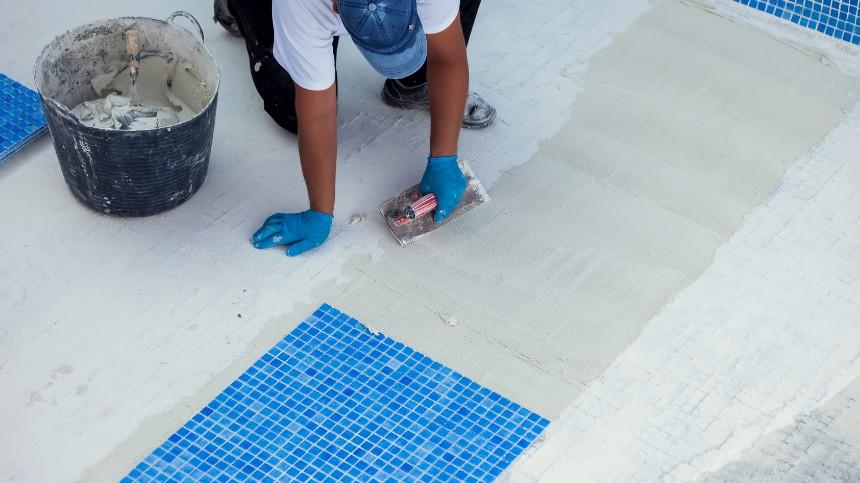
This is the point at which most DIY projects and low-cost contractors fail. Installing swimming pool tiles involves more than just adhering tiles to concrete. It can take days just to prepare the substrate.
The Foundational Truth
Your tiles are only as effective as the floor they’re on. We always begin with a moisture test of that concrete. If it’s too wet, they’re going to fail. If the moisture level is excessive, I would confidently wager that it will cause problems. Next, there is the primer, the waterproof membrane, and then the adhesive bed.
Not installing a waterproof membrane is like building a house without a roof. Water will get through eventually, though it may look promising initially. And with the water movement in Perth’s clay soil, that can mean significant substrate problems.
Expansion Joints: The Unsung Heroes
This information is technical, but I appreciate your attention, as it is important. Pool areas need expansion joints every 3–4 metres to handle thermal movement. Miss these, and you’ll develop stress fractures that spiderweb across your beautiful new tiles.
Most homeowners hate how expansion joints look and ask us to skip them. We say you can have neat, planned joints or ugly, random cracks. Your choice.
Colour and Design Choices That Actually Work Long-Term
Light colours reflect heat and stay cooler underfoot—this should be obvious, but you’d be amazed at how many people choose dark tiles for pool areas and then complain about burning their feet.
But here’s the thing about light colours in pool areas: they show every watermark, leaf stain, and a bit of algae. It’s the eternal trade-off between comfort and maintenance.
The Goldilocks Zone
Medium-toned colours with subtle textures work best, according to our experience. Think warm greys, sandy beiges, or muted blues. They’re light enough to stay reasonably cool but dark enough to hide minor staining between cleanings.
Texture is crucial too. Smooth tiles might look sleek, but they become skating rinks when wet. A light texture provides grip without being rough enough to hurt bare feet or snag pool equipment.
Grouting: Where Most Projects Go Wrong
Standard cement grout has no business around pools. None. It’s porous, stains easily, and breaks down in chlorinated water. Epoxy grout costs more upfront but saves money and hassle long-term.
The grout colour choice matters more than most people realise. Dark grout hides stains but shows calcium buildup clearly. Light grout hides calcium but shows every leaf stain. For the best compromise, we usually recommend going slightly darker than the tile colour.
The Width Factor
Narrow grout lines look modern and sleek, but they’re harder to seal properly and more likely to crack. Wider lines (4-6 mm) provide better structural integrity and are easier to maintain. It’s a case where function should win over form.
Maintenance Reality Check
The finest pool area tiling can still require some regular maintenance. That’s what it really looks like:
- Weekly: Debris should be swept or blown clear, the pool rinsed with fresh water and an examination carried out for loose tiles or cracked grout.
- On a monthly basis: Clean thoroughly with correct cleaners (please don’t use acid-based on natural stone), and verify and clean expansion joints.
- Annually, conduct a professional inspection, perform grout touch-ups, and reseal the natural stone if necessary.
The trick is to outpace problems. A little grout crack you can fix in five minutes today is a big repair job a few months down the road.
Cost Reality: What You’re Actually Looking At
Quality outdoor tiles Perth installations aren’t cheap, but they’re cost-effective over time. We see homeowners spending $8,000—$12,000 for a proper 40-square-meter pool area, including preparation, waterproofing, and quality materials.
For a detailed breakdown of what goes into tiling project costs and how to budget effectively, refer to our comprehensive guide to planning your tile installation budget.
Cheap jobs might quote half that, but they’ll cost more in the long run when you’re redoing the whole area in 3-4 years instead of enjoying 15-20 years of trouble-free use.
The Perth-Specific Considerations
Our soil conditions mean extra attention to substrate stability. Our UV levels mean choosing fade-resistant materials. Our temperature swings mean allowing for thermal movement.
A tiling company that fails to understand these local factors may provide a visually appealing result, but it is likely to fail prematurely. Ask potential contractors about their experience with Perth’s specific challenges and how they address them.
Making the Right Choice for Your Space
There’s no definitive answer for the best pool area tiling solution, as it really depends on your circumstances. There are budget and maintenance issues, aesthetics, and goals in general, as well as the existing state of a property.
But no matter what you decide, don’t skimp on the groundwork. A good tile on a poor base will outperform even top tiles on poor prep.
Your pool space should be one that you are proud of and enjoy for many years to come. With a little bit of planning, making the right material choices, and ensuring skilled installation, your pool space can certainly be enjoyable for many years. The important thing is to work with professionals that are well versed in the technical needs and local issues that make covering Perth pool areas different from anywhere else.
Ready to build a pool area that will look just as appealing in ten years? Let’s discuss what’s doable for your space and situation.